

How Americans Are Brainwashed
When Governing Fails, Culture Wars Become the Only Weapon

I watched the movie Mountainhead the other night. That is not entirely true. I tried to watch it, but I could not make it through. It was so overblown in its grotesque satire that I gave up before the credits rolled.
If you have not seen it, the film is a dark satirical comedy about three billionaire tech bros and one “poor” $500 million tech bro who gather for a weekend retreat in the mountains. Jason Schwartzman plays Souper, the host, who lives in a sprawling 22,000 square foot monument to his own ego. While lounging there, the group discovers that one of their AI apps is triggering a global crisis. Rather than feel any responsibility, they plot how best to profit from the chaos, while wars and social collapse break out across the world.
I bring up this movie because it illustrates, in absurdly exaggerated form, where conservative economic philosophy leads. It is the complete severing of wealth from humanity, the spectacle of men so rich they could solve enormous problems but instead sit idly by, rationalizing suffering. I’m not going to mince words. It is sociopathic.
How Did We Get Here?
That is the haunting question. How did so many people come to believe in an obvious lie that offers no benefit to society at large? For decades, conservatives have clung to the same empty tropes, despite overwhelming evidence about who governs more effectively.
Yes, red states are usually cheaper to live in, but only because demand is lower and because these states chronically under-tax themselves. The result is that they survive on federal subsidies paid by blue states. People with means overwhelmingly choose to live in blue states, not red, because blue states consistently deliver stronger results.
The Data Does Not Lie
If you take into account quality of life, life expectancy, education, health outcomes, infrastructure, cost of living, and economic performance, not one single red state outperforms the average blue state. Some red states manage a bright spot in one category, but across the board they fall behind. The data is not even close (read more from a previous article here).
And this is why conservative politicians fight the culture war so desperately. They know their policies cannot win on the merits. They cannot compete on results. So they must campaign on fear of cultural decline. They inflate social wedge issues that rarely touch daily life in any meaningful way, because this is the only battlefield where they have a chance. That is how creeping authoritarianism takes hold.
Our Own Role in the Slide
It is tempting to blame the politicians, or the media, or the wealthy elite. But there is a hard truth we must face. We all participated in this. We all allowed it. None of this happened by accident. None of it happened overnight. It has taken decades of complacency to arrive at the point where America is once again confronting fascism on its own shores.
And that is where the story of Mountainhead stops being satire and starts becoming prophecy.
How Conservatives Are Convinced to Embrace Economic Policies That Harm Them
The Hook: Fear, Prejudice, and the First Step of Trust
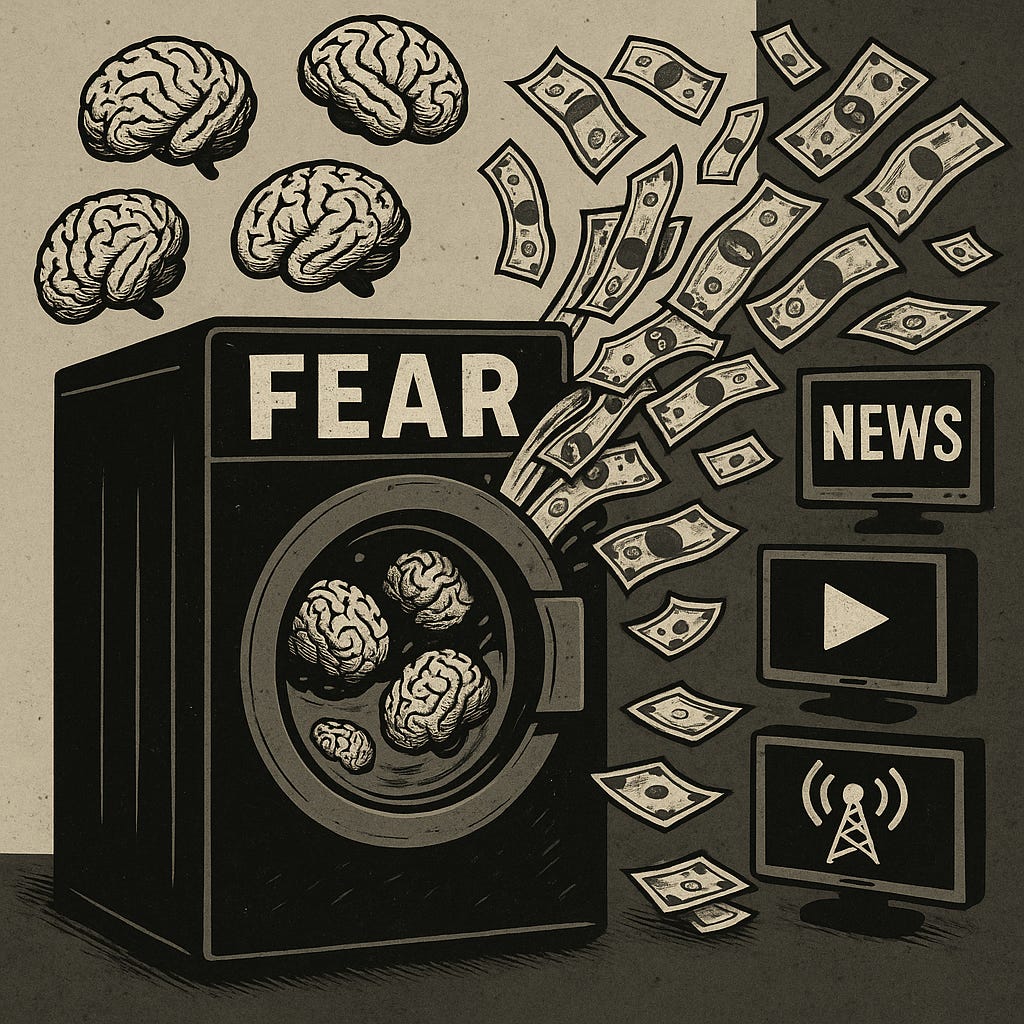
The psychology of persuasion is simple but devastating when applied at scale: begin by affirming a fear or prejudice that someone already holds, and you establish credibility. Conservative media has long relied on this principle. It opens with cultural anxieties, fears about immigrants “stealing jobs,” suspicions about urban crime, or moral panics over schools and “traditional values.” These messages are deliberately designed to tap into an emotional reservoir of fear, resentment, or grievance.
Once this foundation of trust is laid, the audience is primed. If a news source validates your sense that the world is dangerous or that outsiders are threatening your way of life, you are more inclined to trust it when it begins to discuss far less intuitive subjects, like tax policy or financial regulation. And this is the real sleight of hand: the leap from validating cultural fear to smuggling in economic ideology that primarily benefits the wealthy.
Step One: Emotional Capture (The first obvious step)
Fear is sticky. Neuroscience has shown that emotionally charged messages are far more likely to be remembered and repeated than rational arguments. Conservative media leverages this by constantly presenting existential threats: migrants at the border, “radical” progressives in schools, shadowy global elites, or collapsing moral order.
The audience, in fight-or-flight mode, develops a dependency. They return nightly to hear how to protect themselves. This is less about facts than it is about psychological anchoring. Once that dependency forms, the door is open to the next step.
Step Two: The Trojan Horse of Economics
Having won trust on cultural matters, the media introduces economic policy under the guise of common sense. Deregulation is framed as “getting government off your back.” Tax cuts for the wealthy are sold as “job creation.” Gutting social programs becomes “ending waste and fraud.” Each of these ideas is wrapped in the same protective packaging of fear: if government is allowed to regulate, it will “take from you and give to them.”
The brilliance of the strategy lies in its inversion. The very policies that concentrate wealth and power at the top are marketed as defense mechanisms for ordinary people at the bottom. The audience, emotionally hooked on cultural grievances, rarely stops to question whether these economic measures actually improve their lives.
Step Three: The False Promise of Trickle-Down
The economic philosophy is always presented as win-win. If the wealthy are unleashed through deregulation and tax cuts, the prosperity will inevitably “trickle down” to the average citizen. This framing converts structural inequality into delayed gratification: sure, the rich get richer, but just wait, and the benefits will reach you too.
This is not simply an argument; it is a moral narrative. It frames inequality as virtuous, even necessary, for growth. And for conservatives who have already been told the world is a battlefield, it sounds like the only way to arm the “good guys” in the fight.
Step Four: The Enemy Within
Any counter-argument must be neutralized. Enter the scapegoat. Whenever critics highlight the failures of deregulation or the real-world harms of tax cuts, the media blames “liberal elites,” “deep state bureaucrats,” or “welfare freeloaders.” By painting alternative explanations as the words of untrustworthy enemies, the audience is immunized against dissent.
This technique ensures loyalty. Even when conservative voters feel the pinch of policies that dismantle healthcare, weaken labor protections, or cut public schools, they are encouraged to blame the “other side” rather than question the policy itself.
Step Five: Manufactured Identity
Over time, economic ideology fuses with cultural identity. Supporting deregulation, opposing taxation, and embracing “small government” become signals of belonging to the conservative tribe. At this point, the manipulation no longer needs to be persuasive in a rational sense. It becomes a marker of loyalty, a badge of who you are. To question it risks exile from your community.
The Fear-Economics Two-Step
The result is a kind of tragic comedy, where viewers are lured in by fear or a prejudice that feels familiar, only to have propaganda quietly slipped between the segments. It ends up looking something like this:
Anchor: “Tonight, shocking footage from the border. Waves of migrants are crossing unchecked, threatening your safety, your jobs, and your children’s future.”
Viewer: “That’s terrifying. Someone has to stop it.”
Anchor: “Exactly. And you know what else threatens you? Government red tape. Regulators want to strangle small businesses with rules about safety, wages, and the environment. If we cut through that, the economy will soar and you’ll be safer, too.”
Viewer: “So the border and regulations are both out of control?”
Anchor: “You’re catching on. Now, here’s another story. In your local schools, radical leftists are pushing inappropriate books and brainwashing kids with progressive values. Families are under siege.”
Viewer: “That explains why everything feels so unstable.”
Anchor: “And instability is why we need tax relief for job creators. If the wealthy can keep more of their earnings, they’ll invest in strong communities, create jobs, and shield us from the chaos.”
Viewer: “So tax cuts protect us from cultural decline?”
Anchor: “Of course. And speaking of decline, did you hear about violent crime skyrocketing in our cities? Liberal mayors have turned once-proud places into war zones.”
Viewer: “I knew it was getting bad.”
Anchor: “That’s why government must shrink. Less spending on wasteful social programs, fewer resources for bureaucrats, and more freedom for businesses to operate. A leaner government means a safer America.”
Viewer: “It all connects. If we don’t cut government, we’ll lose everything.”
Anchor: “You’ve got it. Fear at the border, danger in the schools, crime in the streets. But deregulation, tax cuts, and small government will keep you safe and prosperous. Just remember, the other side wants the opposite.”
The Outcome: A Captive Audience, an Empowered Elite
The result of this step-by-step brainwashing is that conservatives, many of them working-class, have been convinced to support policies that overwhelmingly benefit the wealthy and powerful. Deregulation makes corporations less accountable, tax cuts hollow out public services, and government slashing leaves ordinary citizens without safety nets. Yet through the psychological pipeline of fear → trust → Trojan horse → scapegoat → identity, these harmful policies feel not only acceptable but righteous.
The irony is profound: voters are persuaded to vote against their own material interests, believing that by protecting the wealthy, they are protecting themselves. Meanwhile, the beneficiaries — the billionaire class and their political enablers — expand their wealth and influence without resistance.
Breaking the Spell
Seeing the pattern is the first step to breaking it. None of this is random. It is a deliberate strategy, refined over decades, that uses fear as bait and smuggles in economic dogma as the supposed cure. Once you recognize the trick, the sleight of hand becomes obvious.
The task for a democratic society is not just to point out the damage after the fact, but to shine a light on the psychological machinery that makes the deception work in the first place. If that machinery is left intact, the performance will go on: fear at the opening act, wealth extraction as the finale, and an audience left wondering why the story always ends with them poorer, angrier, and still waiting for the promised payoff.
Sources
1. Red vs. Blue State Outcomes
CDC, National Center for Health Statistics – Life expectancy data by state (shows stark red-blue differences).
https://www.cdc.gov/nchs/pressroom/sosmap/life_expectancy.htmU.S. Census Bureau – State-level poverty, education, and income metrics.
https://www.census.gov/Commonwealth Fund – Annual State Health Rankings report comparing outcomes across all 50 states.
https://www.commonwealthfund.org/publications/fund-reports/2023/2023-state-health-system-performance-scorecardBrookings Institution – Analyses of state-level economic and social policy impacts. https://www.brookings.edu/
2. Conservative Messaging & Media Strategy
Hofstadter, Richard. The Paranoid Style in American Politics – Classic work on fear and resentment in conservative narratives.
https://harpers.org/archive/1964/11/the-paranoid-style-in-american-politics/Jamieson, Kathleen Hall & Joseph N. Cappella. Echo Chamber: Rush Limbaugh and the Conservative Media Establishment – On trust-building and persuasion techniques in conservative media.
https://global.oup.com/academic/product/echo-chamber-9780195300040Benkler, Yochai; Faris, Robert; Roberts, Hal. Network Propaganda: Manipulation, Disinformation, and Radicalization in American Politics – Deep dive into how conservative media ecosystems build loyalty and distort economic policy perceptions.
https://global.oup.com/academic/product/network-propaganda-9780190923626
3. Psychology of Fear & Persuasion
Daniel Kahneman, Thinking, Fast and Slow – On emotional capture, anchoring, and why fear-based messaging works better than rational appeals.
https://us.macmillan.com/books/9780374533557/thinkingfastandslowGeorge Lakoff, Don’t Think of an Elephant! – Explains framing, identity, and why conservative narratives stick.
https://chelseagreen.com/product/dont-think-of-an-elephant/Neuroscience research on fear retention – “Fear memories and their persistence: The basics” (Nature Reviews Neuroscience).
https://www.nature.com/articles/nrn3498
4. Economic Policy Outcomes
Thomas Piketty, Capital in the Twenty-First Century – Wealth concentration and inequality.
https://www.hup.harvard.edu/catalog.php?isbn=9780674979857Joseph Stiglitz, The Price of Inequality – How deregulation and tax policy favor elites at the expense of the working class.
https://wwnorton.com/books/9780393345063Economic Policy Institute (EPI) – Research on wage stagnation, tax policy, and inequality. https://www.epi.org/
Center on Budget and Policy Priorities (CBPP) – Data on tax cuts, social program funding, and state budget impacts. https://www.cbpp.org/
5. Historical & Political Context
Nancy MacLean, Democracy in Chains – On how conservative elites deliberately built strategies to reshape democracy around economic privilege.
https://www.penguinrandomhouse.com/books/251881/democracy-in-chains-by-nancy-maclean/Heather Cox Richardson, How the South Won the Civil War – On the long conservative tradition of fusing economic privilege with cultural grievance.
https://global.oup.com/academic/product/how-the-south-won-the-civil-war-9780190900900